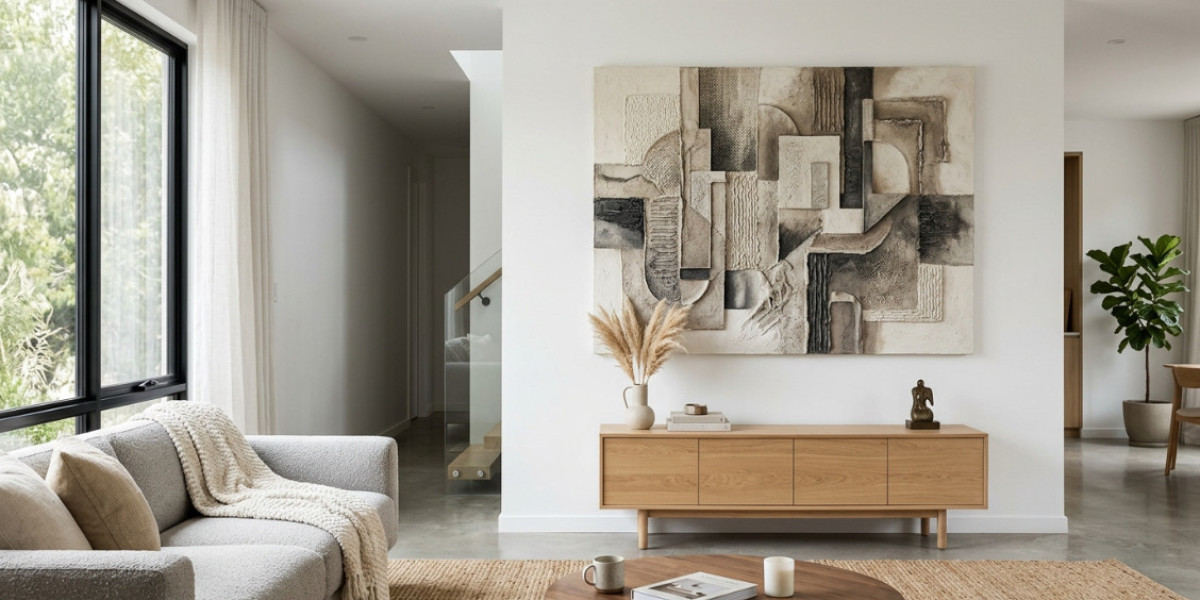

Modern interiors have spent the last decade chasing minimalism, but a quieter countertrend has emerged around Wall Art Design that prioritizes dimension over flatness. Instead of smooth prints or single-tone canvases, homeowners are increasingly drawn to pieces with raised surfaces, layered materials, and sculptural brushwork that give a room genuine physical presence.
This shift makes sense when you consider how much of daily life now happens in front of screens. Phones, laptops, and televisions are uniformly flat, and that flatness has started to feel sterile when echoed across the rest of a living space. A textured painting breaks that pattern immediately, offering something the eye cannot fully process from a glance, encouraging a slower, more deliberate kind of looking.
Designers working on contemporary homes often treat textured wall art as a counterbalance to hard architectural lines. A room with sharp angular furniture, polished concrete floors, or floor-to-ceiling glass benefits enormously from a single textured piece that introduces organic irregularity. The contrast between rigid structure and tactile, imperfect surface creates visual tension that feels intentional rather than accidental.
Material choice matters significantly in this design approach. Heavily layered oil or acrylic pieces tend to suit warm, traditional spaces, while plaster-based or mixed-media textured works often complement industrial or Scandinavian-inspired interiors. Studios such as Artextured have built collections specifically designed around these pairings, giving designers a reference point for matching texture style to room character.
Scale and placement deserve equal attention. A large textured piece above a sofa or bed becomes the room's anchor, while smaller textured works grouped together can create a gallery wall with varying tactile rhythm. Either approach benefits from adequate negative space around the piece, since texture needs breathing room to read clearly rather than competing with other busy decor.
As more homeowners prioritize spaces that feel personal and lived-in rather than showroom-perfect, textured wall art design is likely to keep growing as a category of its own, separate from traditional flat painting and print markets.
Budget-conscious buyers sometimes assume textured wall art is reserved for high-end interiors, but the category spans a wide price range, from smaller accent pieces with modest surface relief to large-scale statement canvases with deep, sculptural buildup. Choosing texture intensity based on budget rather than size alone can help homeowners introduce dimensional art into a room without overspending on an oversized piece.
Framing decisions also differ for textured work compared to flat prints. Because raised surfaces extend beyond the canvas plane, deep-set frames or no frame at all tend to work better than thin, shallow moldings that can visually clip the artwork's dimensional edges. Many designers recommend leaving heavily textured pieces unframed entirely, allowing the canvas edge itself to remain visible as part of the overall composition.
Seasonal lighting changes are another practical consideration. A textured piece that looks subtle during long summer days, when light enters a room from a higher angle, may appear noticeably more dramatic during winter months when lower-angled light rakes across the surface and casts longer shadows.
Color temperature within a room also influences how textured art reads against a wall. Warm-toned lighting brings out the golden and amber undertones in earthy textured pieces, while cooler daylight-balanced lighting tends to emphasize the shadows and contrasts across raised surfaces more crisply. Understanding this interaction helps homeowners plan which wall to use and whether supplementary picture lighting might enhance a piece beyond ambient room lighting alone.
Frequently Asked Questions
What rooms benefit most from textured wall art? Living rooms, primary bedrooms, and entryways tend to benefit most, since these spaces are viewed from multiple angles and distances throughout the day.
Should textured art match the wall color? Not necessarily. A slight contrast between the artwork's base tone and the wall color often helps the texture stand out more clearly.
Is textured wall art suitable for humid rooms like bathrooms?Generally no, since prolonged moisture exposure can affect paint or plaster-based textures over time; drier living spaces are better suited.